Configure the search
Set program tag, sectors, geographies, project signals, capex range, rural preference, and exclusion rules at run time.
§ Platform - CORE Lead Discovery
CORE Lead Discovery helps lenders search for expansion, facility, rural, capex, and program-fit borrower signals before a borrower is ready for a loan package - then gives origination users a controlled path from candidate review into CRM and the working deal pipeline.
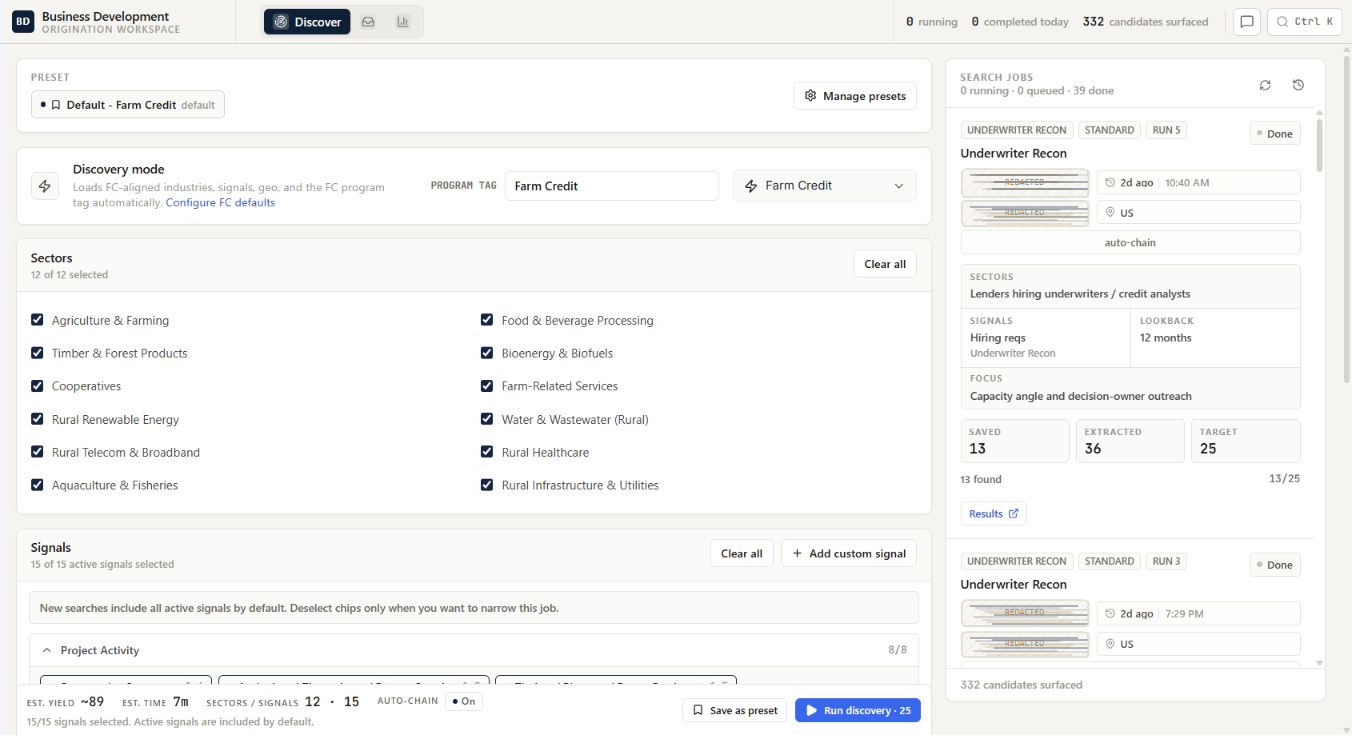
A search can be configured around program tag, geography, sectors, capex range, rural preference, exclusion rules, ideal targets, and skip rules. CORE then uses multi-agent search, source catalogs, duplicate checks, and scoring to produce candidates for human screening.
Program signal -> multi-agent search -> screening -> CRM relationship -> pipeline§ Discovery Product
Set program tag, sectors, geographies, project signals, capex range, rural preference, and exclusion rules at run time.
CORE looks for facility, expansion, investment, rural, and program-fit signals while skipping leads that do not match the policy.
Federal, state economic development, wire, trade, local news, and other sources give the agents places to search beyond generic scraped lists.
Candidates are scored, checked against existing borrower leads, and kept out of the queue when they are duplicates or poor fits.
Humans accept, reject, enrich, or defer candidates before they become active relationship records or financing opportunities.
When a relationship becomes a real financing opportunity, an origination user creates and links the pipeline deal in CORE Workflow.
§ Fit
This is not generic CRM prospecting. It is borrower discovery against a lender's configured origination thesis.
Program-tagged borrower discovery for public programs, private credit strategies, and specialty credit markets
Run-time search guardrails for geography, sector, capex, facility signals, and rural preference
AI extraction guidance for ideal targets, mandatory skips, capex guidance, and size guidance
Multi-agent web and catalog search with duplicate protection
Human review queue before accepted candidates enter the active CRM relationship set
Controlled promotion from accepted relationship to linked pipeline opportunity
COREView-informed market theses and outreach context
§ Path
Choose the program, geography, sector, borrower signal, capex band, and skip rules for the search.
CORE searches web results and curated source catalogs, extracts candidates, scores them, and filters duplicates.
The origination user accepts, rejects, enriches, or defers each candidate before it becomes an active CRM relationship.
When the relationship becomes a financing opportunity, the user creates and links a pipeline deal; qualified deals can later convert into controlled borrower projects.
§ In Depth
Generic prospecting software ranks companies by static firmographics — industry code, headcount, revenue band. Lending origination runs on events: an expansion announcement, a new facility, a capital project, a rural operation reaching the size where program financing fits. CORE Lead Discovery searches for those signals, because a borrower exists at the moment their project does.
Every search is configured at run time around the lender's actual appetite: program tag, geographies, sectors, capex band, rural preference, ideal-target guidance, and mandatory skip rules. Multi-agent search works through curated source catalogs — federal and state economic development sources, trade and local business press — rather than one generic scraped list, and guardrails discard what the thesis excludes.
Candidates are scored, checked against existing leads and CRM records for duplicates, and held in a review queue. An origination user accepts, rejects, enriches, or defers each one - nothing becomes an active relationship or financing opportunity on the model's say-so, and outreach remains human-approved.
Accepted candidates remain inside the CRM relationship system rather than a separate lead database. When the relationship becomes a real financing opportunity, the origination user can create and link a pipeline deal, then convert the qualified deal into the borrower project when formal credit work should begin.
§ Next Step
The BD layer should create better borrower opportunities, not another list to clean up.