Claim lineage
Memo claims point back to accepted facts, documents, regulations, or controlled system records.
§ Platform - Examiner Defense
CORE is designed around the moment after the memo is written: when someone asks where the number, claim, policy interpretation, or analyst decision came from.
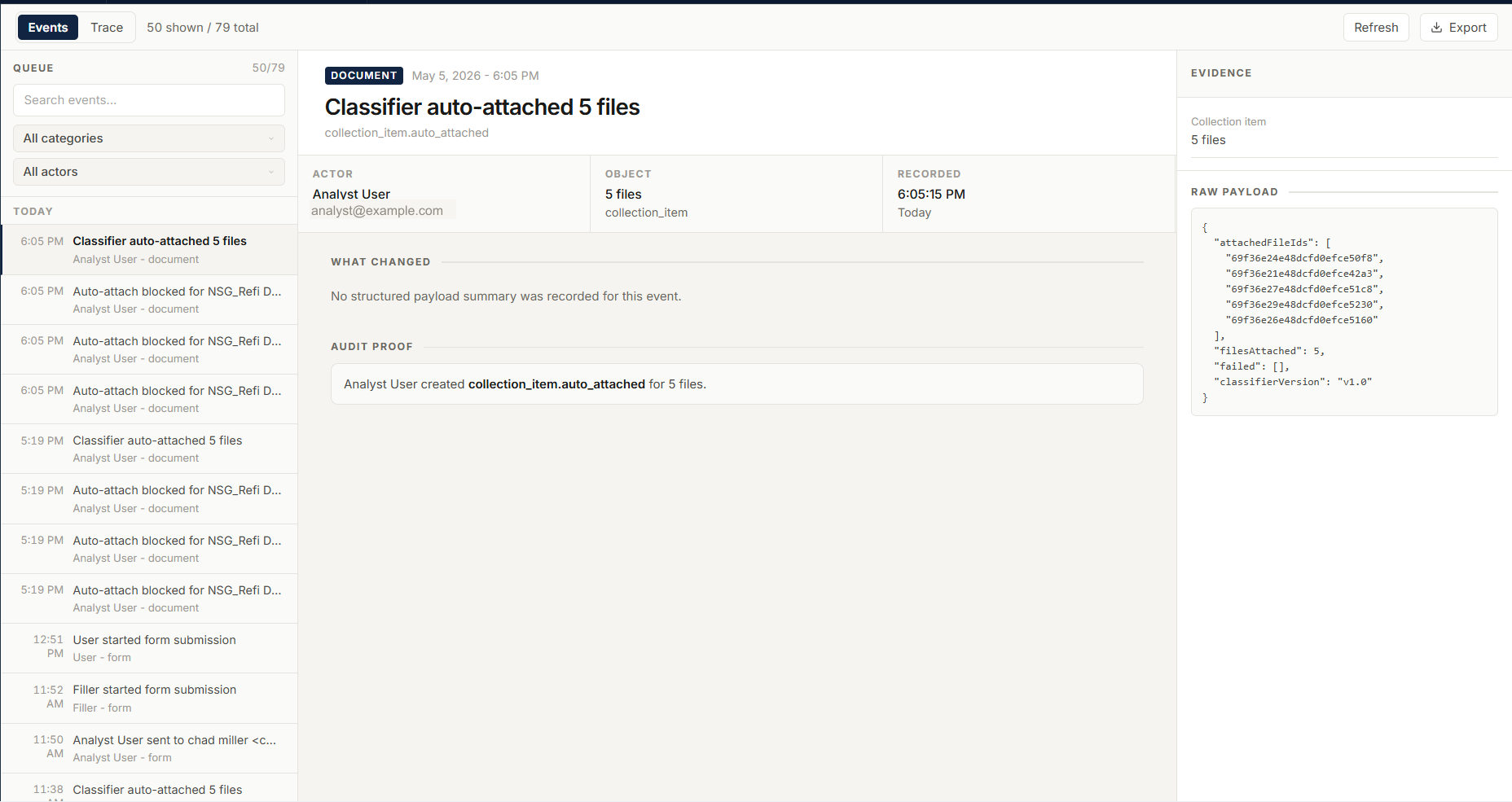
Every accepted model output, analyst edit, file action, and source-backed claim should leave a trace that can be replayed without rebuilding the file by hand.
Redacted audit log surface§ Audit Controls
Memo claims point back to accepted facts, documents, regulations, or controlled system records.
CORE separates generated recommendations from the human decision that accepted or changed them.
Event history lets the team answer who did what, when, and against which source.
§ Fit
This is a cross-product audit capability, not a separate product: the file should answer an examination or diligence question from the work already recorded.
Event-level audit history
Source-cited memo claims
Accepted, edited, and rejected AI output records
Document and entity lineage
Filtered export for internal or external review
§ Path
Where did this claim, figure, or conclusion come from?
CORE resolves the claim to a document span, fact, rule chunk, or event.
See whether the analyst accepted, edited, rejected, or superseded the signal.
Package the evidence trail for internal review or examination support.
§ In Depth
Years after a loan closes, someone asks where a number came from, why an exception was granted, or what the analyst saw before signing off. In a typical stack the answer is scattered across email threads, workbook versions, and memories of people who may have left. The reconstruction takes days and still reads like an apology.
CORE is built so the file answers the question from work already recorded: memo claims resolve to accepted facts, documents, regulations, or controlled system records; analyst decisions are logged separately from model proposals; and event history shows who did what, when, against which source.
Because policy is bound to the deal as a versioned snapshot and every generation run is frozen with its inputs, the file can be replayed as it stood at decision time — not re-argued from today's data. That distinction is what turns an examination finding into a five-minute lookup.
The same replay serves credit committee challenges, investor and LP diligence, and ordinary internal credit review. Any audience with the standing to ask "prove it" gets the same answer: the recorded trail, not a reconstruction.
§ Next Step
That is the right demo path for CORE.