Cite or decline
CORE answers only when a claim can be grounded in a file, rule, accepted fact, table, or controlled system record.
§ Platform - CORE Credit Memos - AI Governance
CORE treats AI output as proposed credit work. Claims need sources, model runs need snapshots, and the analyst owns the decision before anything enters the file.
Every generation resolves through a controlled source substrate, model registry, section route, policy context, regulatory context, analyst action, and event history so model upgrades do not rewrite prior credit work.
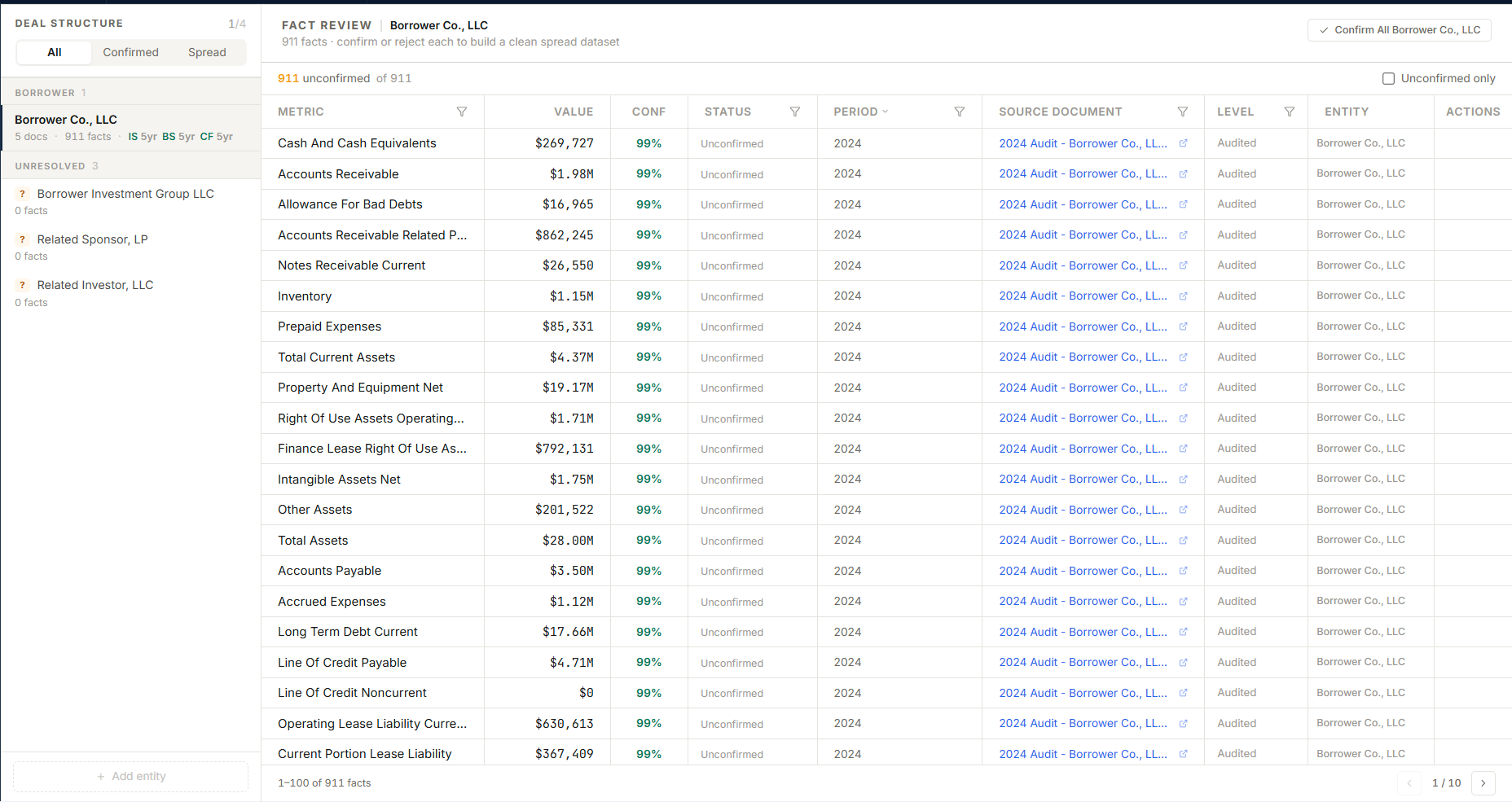
Fact review before downstream use§ Governance Layer
CORE answers only when a claim can be grounded in a file, rule, accepted fact, table, or controlled system record.
Document extraction, spreading, memo drafting, policy review, and regulatory retrieval each run through the right controlled workflow.
Model, inputs, output, source context, policy context, and prompt package are frozen against the file.
The AI proposes. The analyst accepts, edits, or rejects. CORE logs the human decision separately.
Regulatory chunks, policy thresholds, templates, and agent instructions are versioned so old decisions can be understood later.
Every AI action lands in the project event history with enough context to replay the work.
§ Fit
The point is not to make AI sound safe. The point is to control where it can act, what it can see, and who can approve the result.
Source substrate and cite-or-decline rules
Model registry, prompt package, and generation snapshots
Program-routed prompts, specialists, and review patterns
Internal credit policy and platform regulatory context by section
Analyst-owned acceptance, edit, reject, and override workflow
Audit trail for generated, reviewed, and human-edited work
§ Path
Find source material from the file, accepted facts, regulations, policy records, or controlled tables.
Send the work through the correct specialist, section intent, support package, and review path.
Draft only against retrieved context, credit policy, regulatory rules, and the section mandate.
The analyst accepts, edits, or rejects the generated work before it becomes part of the file.
§ In Depth
When a lender's risk team evaluates AI in the credit process, the questions are concrete: which model ran, what did it see, who approved the output, and can we explain this decision after the model is upgraded? CORE's answers are artifacts — a model registry, frozen generation snapshots with the full prompt package, cite-or-decline grounding, and a separately logged human decision — rather than a policy statement about being careful.
In consumer software, a hallucinated sentence is a bad experience. In a credit file, it is a defect in a record that committees, investors, and examiners rely on. CORE generates only claims that can be grounded in a file, rule, accepted fact, table, or controlled system record — and declining to answer is treated as correct behavior when no source exists, not as a failure to be papered over.
Regulatory chunks, policy thresholds, memo templates, and agent instructions are versioned, and every run is snapshotted against the file. Work produced under last year's model and last year's policy remains explainable as exactly that — which is the property that lets a credit shop adopt better models without losing the ability to defend prior decisions.
§ Next Step
If the AI cannot be replayed, it does not belong in high-stakes credit work.