Document authority
Audited statements, reviewed statements, compiled statements, internals, and tax returns have an explicit precedence model instead of silently mixing.
§ Platform - CORE Underwriting - Credit Analysis & Spreading
CORE spreads borrower financials from source documents, pins years to the right evidence, exposes rejected candidates, and keeps provenance visible so analysts can explain every number before it reaches policy or memo work.
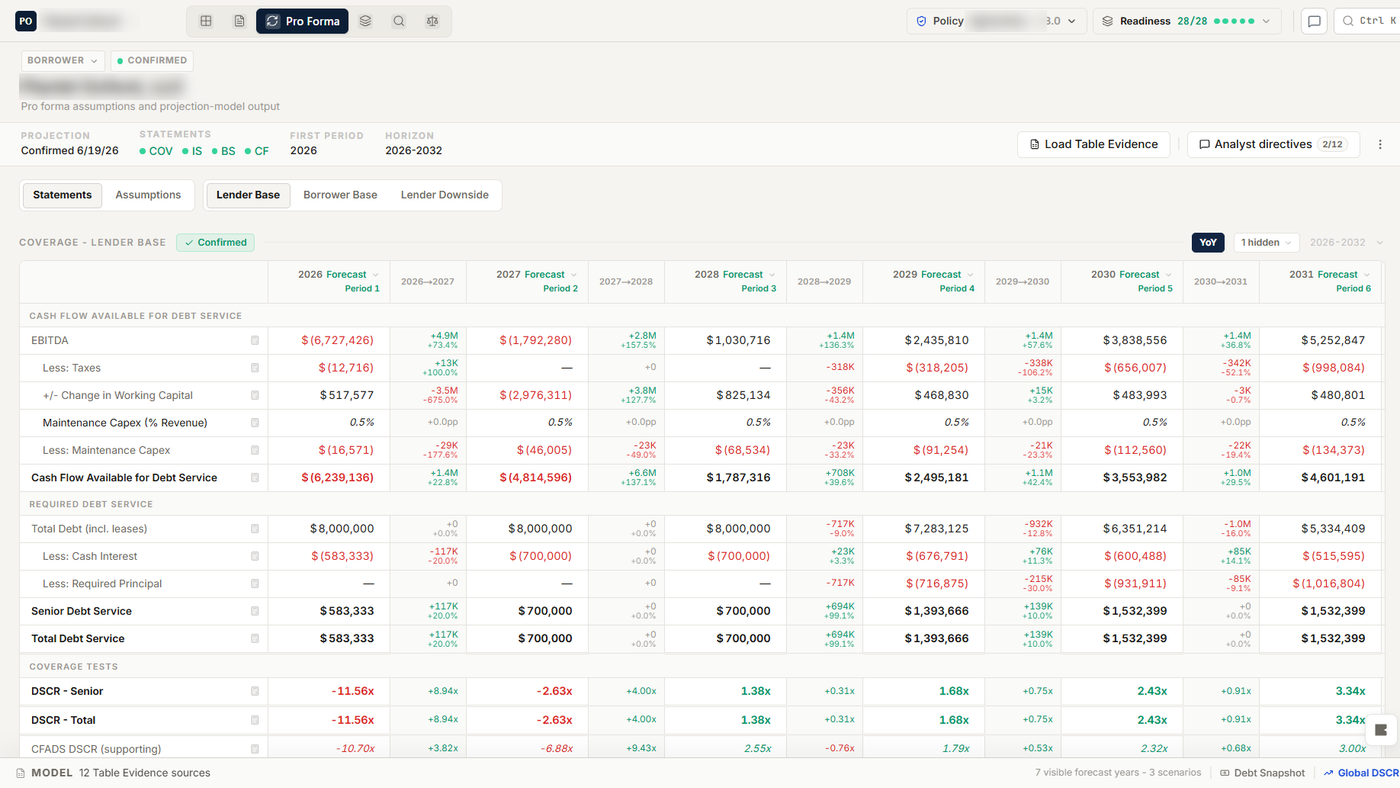
The analyst can compare lender base, borrower base, and downside cases; inspect YoY movement; load Table Evidence; and trace projected cash flow through debt service into DSCR without leaving the underwriting file.
Confirmed projection horizon · three scenarios · cash flow through DSCR§ Spreading Controls
Audited statements, reviewed statements, compiled statements, internals, and tax returns have an explicit precedence model instead of silently mixing.
Rejected candidates are logged, not lost, so an analyst can see what the engine considered and why a source did not win.
Analysts can override a cell, force a source, or pin a document while preserving the reason in the spread record.
CORE computes institutional subtotals, flags reconciliation gaps, and keeps extracted source values behind formula outputs.
Confirmed spreads publish metrics to policy and memo workflows. Unconfirmed spreads remain visible, but they do not become decision inputs.
Product Proof
Two proof points matter: the analyst can confirm the financial state, and the institution can reconstruct why each published value won.
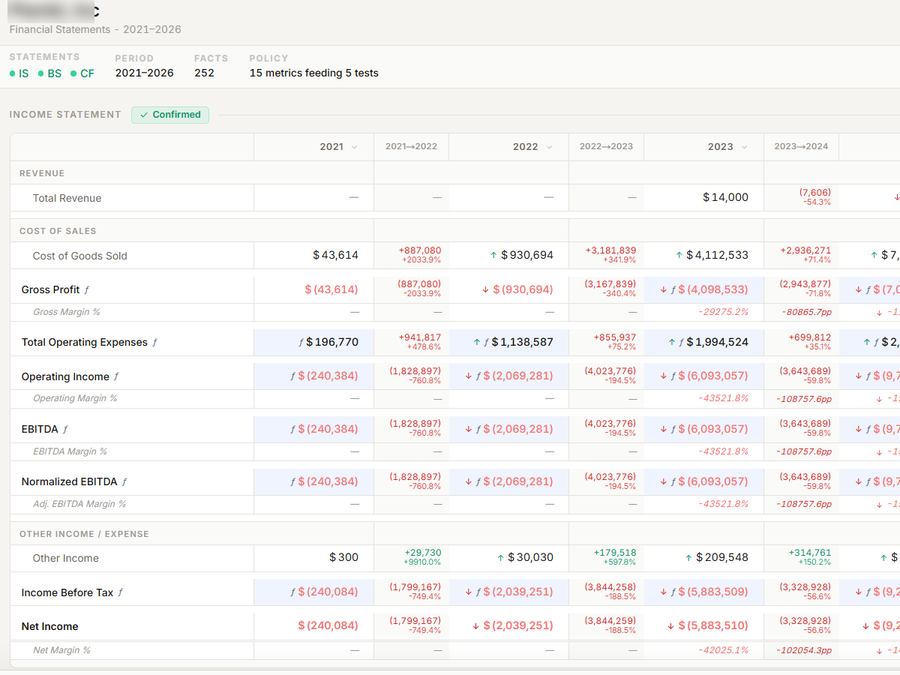
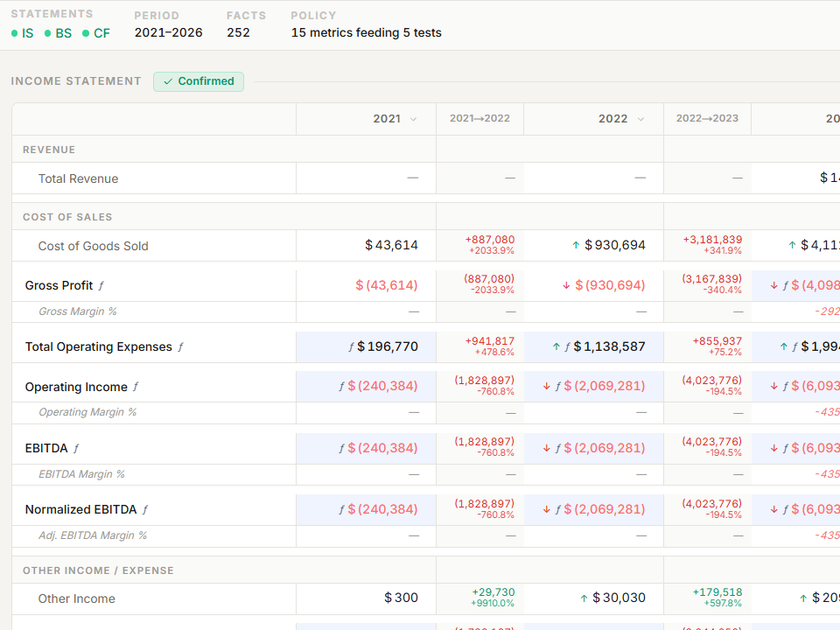
Confirmed financial state
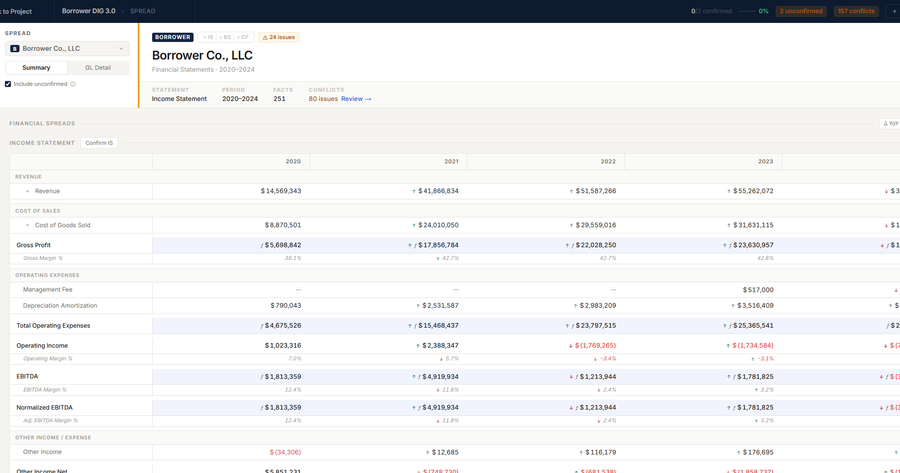
Multi-period statements, transition analysis, derived metrics, policy links, and quality state remain in one controlled spread rather than separate spreadsheet tabs.
Source authority
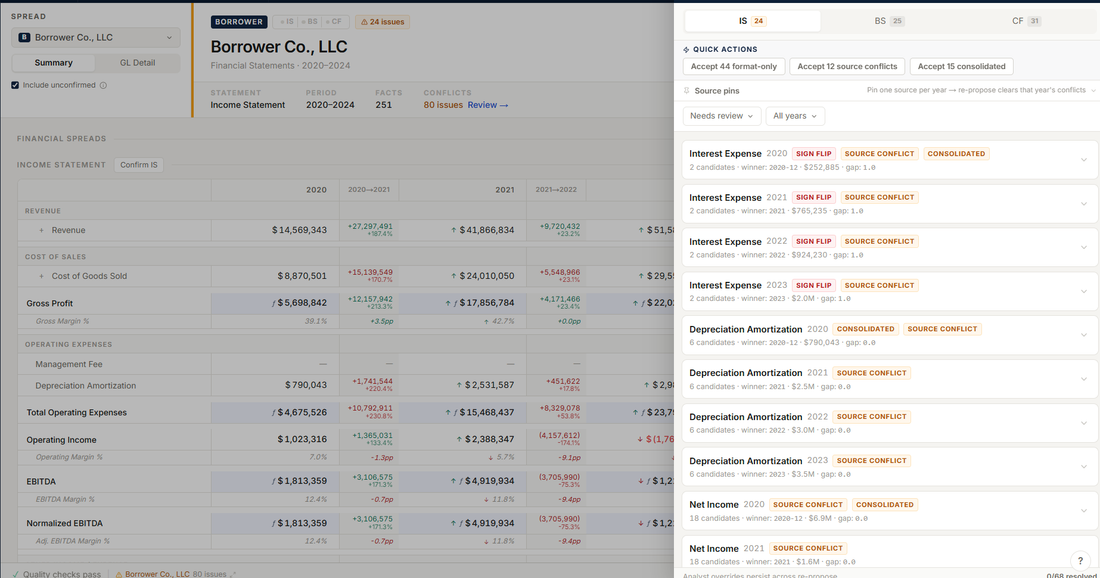
Competing facts, document authority, overrides, and provenance remain visible beside the value so review does not end at a populated cell.
§ Fit
Analysts keep control of source authority, overrides, confirmation, and the evidence behind every published metric.
Entity-level and consolidated financial views
Fact review and confidence state
Coverage map by statement and fiscal year
Document pinning and source overrides
Cell provenance, collision review, and formula breakdowns
Derived cash flow preview and reconciliation checks
Confirmed-spread gate before policy tests consume metrics
§ Path
Document facts enter the review table with confidence and source document.
CORE proposes source-pinned years and logs competing facts before they become spread cells.
The analyst confirms facts, overrides cells, pins documents, or forces a source when the file requires judgment.
Only confirmed spreads publish metrics into coverage, risk, and memo generation.
Material movement, reconciliation issues, and derived cash-flow signals become source-cited credit context.
§ In Depth
Most financial spreading software treats the problem as extraction: read the statement, fill the grid. But the work that consumes analyst time is the long tail of judgment underneath — line items that go by different names across years, footnotes that bleed into comparative columns, a sub-entity tax return that disagrees with the consolidated audit, Schedule L balances that do not match the face of the statement.
A spreading tool that silently mixes those sources produces a grid an analyst cannot defend. CORE treats every one of those conflicts as a first-class object: competing facts are scored, the losing candidates are kept in a collision log for review, and the analyst can see exactly what the engine considered before a number became a cell.
CORE ranks financial sources the way a credit shop does: audited statements over reviewed, reviewed over compiled, compiled over internal, internal over tax returns. Years are auto-pinned to the most authoritative document available, and the precedence is visible — so when a reviewer asks why fiscal 2024 came from the audit rather than the return, the spread itself answers.
Analysts stay in control throughout: override a cell, force a source, or pin a document, and the reason is preserved in the spread record rather than lost in a spreadsheet comment.
In CORE, an unconfirmed spread is visible but inert. Only when the analyst confirms a spread do its metrics publish into coverage, policy tests, risk analysis, and credit memo work — and every blank carries a recorded reason, so a missing value explains itself instead of looking like an oversight.
That confirm gate is what makes AI-assisted statement spreading safe for regulated and committee-reviewed lending: the model accelerates the work, and the analyst's confirmation is the event that lets a number carry decision weight.
A spread is only useful when it moves: into debt-service coverage, policy thresholds, scenario pro formas, and ultimately the credit memo. Because spreading lives inside the same borrower file as the rest of CORE Underwriting, confirmed financials flow directly into those surfaces with their evidence trail intact.
§ Next Step
We will show how CORE exposes the difference instead of hiding it in a workbook.