The staffing paradox
Institutions building commercial or government-guaranteed capacity need large-bank analysis discipline without a large-bank analyst bench.
§ Compare - For Community Banks & Credit Unions
Community banks and commercial-growth credit unions run on established cores and LOS platforms that are genuinely hard to replace - and mostly should not be. The gap is what happens between intake and decision: spreads in workbooks, memos in Word, policy in a PDF, evidence in email.
CORE can receive a qualified deal from the existing stack or manage the relationship and opportunity in its native CRM and pipeline. Either way, it deploys beside the core and LOS rather than requiring a core conversion.
Comparison pages use careful factual claims§ What To Compare
Institutions building commercial or government-guaranteed capacity need large-bank analysis discipline without a large-bank analyst bench.
Spreading, policy evaluation, evidence, and memo drafting carried under human control changes what a three-person credit team can produce.
CORE owns the borrower file's underwriting and evidence work and hands records downstream - adoption is a program and a team, not a conversion project.
Source-cited analysis, human approval records, and replayable history support examiners, committees, and model-risk review alike.
Teams can use native CRM and pipeline to carry relationship context into the borrower project without replacing the institution's core.
§ Fit
No core conversion, no LOS displacement: the judgment layer deploys as its own workspace on the borrower file.
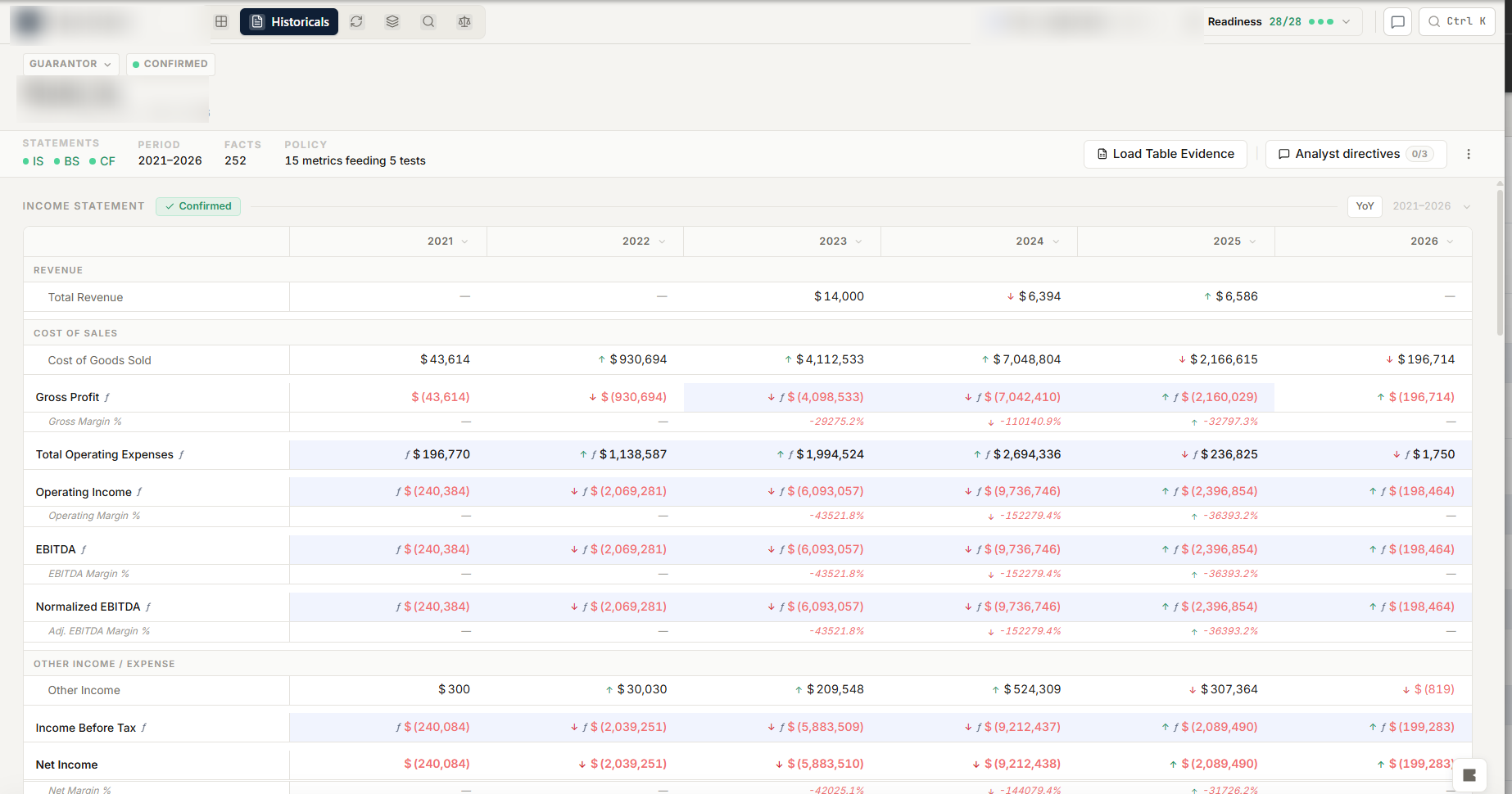
Financial spreading with document authority and analyst confirmation
The institution's own credit policy as versioned configuration
Underwriting workspace for complex and multi-entity commercial deals
Program configurations for first SBA or USDA lending programs
Memo generation under cite-or-decline and human review
Optional native CRM and configurable pipeline for a connected relationship-to-credit path
§ Path
Start with the commercial or government-guaranteed program where deals slow down most.
Policies, collection packages, and memo structure deploy as the institution's own configuration.
Start with qualified deals from the existing stack, or use CORE CRM and pipeline upstream when the relationship handoff is part of the problem.
Approved records flow to the existing systems the institution already trusts.
§ Next Step
We will show the judgment layer working beside the systems you already run.